The Man in the Back Room

Cameron McVey on Buffalo, Blue Lines in a terraced house, and why the back room suits him.

KULTUR // Kultur SessionsPage 01

Buffalo · Blue Lines · a terraced house in West London

The Man in the Back Room

Cameron McVey — photographer, Buffalo fixer, and the producer behind Blue Lines — on hearing the world for his blind mother, handing his cameras to Jamie Morgan, and why he still signs his records Booger Bear.

Interview · Barnzley  |  Guest · Cameron McVey

I saw everything through sound, because I had to describe things to my mum.

Cameron McVey has spent forty years being the person other people’s records could not have happened without, and almost none of that time being the person on the sleeve. He learned to hear before he learned to work: his mother was blinded at five, and the house was full of music because music was the part of the world she could still enter unassisted. Everything he saw, he described out loud.
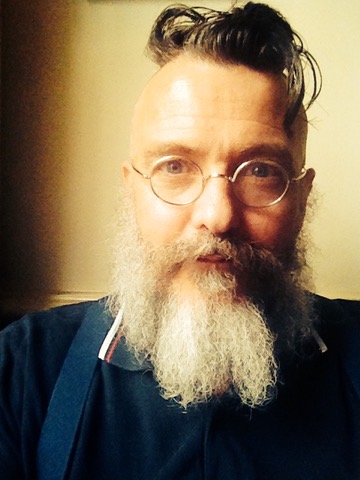
Portrait of Cameron McVey
Cameron McVey · “A giant pair of headphones” — the converted garage

He came into the business sideways, as fashion photographers sometimes do — bored of stills, into commercials, into MTV with Jamie Morgan. Through Roger Charity he met Ray Petri, who came to assist him and turned out to be the better stylist, the better maker of concepts, the guru of the whole Buffalo circle. McVey became the one who made sure Ray got paid.

By the time Buffalo was a movement he had handed his cameras to Morgan and Marc Le Bon and moved to the back room permanently. A jeans commercial with no music budget put him in a studio for the first time; the demo got him a record deal; the record was a boy-band single now filed under cult classic. The B-side had a girl he had met on a plane to Tokyo on it. She was better than the A-side. Her name was Neneh Cherry, and he has been married to her for twenty-five years.

What followed reads like a list of other people’s triumphs: Buffalo Stance. Blue Lines, seventy-five per cent of it made in a terraced house in West London. All Saints. Sugababes — both timed, deliberately, to whichever of his children was the right age to tell him the truth. He is still there now, cutting up EPs for Massive Attack in a converted garage, producing Chrissie Hynde, holding hands.

KULTUR · No. 2 · Cameron McVey01
KULTUR // Kultur SessionsPage 02

Everything Through Sound

Edited for clarity and length.

How did you get into music in the first place?

Mainly because my mother was blind. We always had a lot of music playing around the house, and I think that gave me a real conscious view on everything to do with audio. I saw everything through sound, because I had to describe things to my mum. She saw everything through the eyes of a five-year-old child, because she was blinded when she was five.

Then I got into the business because I was a fashion photographer and I was getting bored with it. I started directing commercials, and directing for MTV with Jamie Morgan, one of the Buffalos.

Tell me about the Buffalo thing — how did you get involved with Ray Petri?

I met Ray through Roger Charity, a photographer friend of mine, and he started assisting me. Then I realised he was a better stylist and a better sort of concept maker. He was a bit of a guru for all of us, really. In a way Ray became my substitute dad. And I became the brains behind making sure Ray got paid, because he was really bad with money — so I did all the deals.

By the time Buffalo happened I was bored with photography as a business, so I handed my cameras on to Jamie and to Marc Le Bon, and got on with helping Ray do the deals. I oversaw the whole business side of it.

And then there was a music project with Jamie.

Before that I was directing a commercial for a jeans company from Lebanon called Punky Jeans. The budget could only do our idea for the visual, not the music, and we didn’t want to compromise the visual — so I said, it can’t be that hard. We went into the studio and made some music, at Paul Kaplan’s place. He was really into it, so he offered us a record deal. That’s how we formed Morgan McVey and did this horrible boy-band thing, which is now a cult classic.

And the B-side?

By that time I’d met Neneh on the way to Tokyo, weirdly enough — we were both modelling for Takeo Kikuchi, because Ray had been asked to find models. I was working at PWL as a co-writer, and Pete Waterman asked me to find singers. I put Neneh on the B-side of the single they produced. I worked on it with Nellee Hooper. It became more popular than the A-side, because it was a lot better. Then I decided to jump ship and become a producer.

The B-side was better than the A-side. So I jumped ship and became a producer.

Blue Lines, Made at Home

We were being managed by someone and it wasn’t working out, and Massive Attack were heading towards the same management company. We ended up asking them if they wanted to join our little company. Nellee was supposed to produce the album with Jazzy and they couldn’t do it, so I ended up producing Blue Lines.

Which is a total classic. Yeah, I guess so. Now, twenty years later, I’m their friendly backroom advisor.

Seventy-five per cent of it, in our terraced house in West London. The last quarter we did down at Coach House in Bristol. It was very much an experiment — us floundering around. That hasn’t changed. We basically didn’t know what we were doing, so we got there by process of elimination, which is pretty much how I make every record. I always go into the studio thinking I’ve never worked before.

That first album took a year and nearly cost me a marriage. It was hardcore. They were new, and there was London versus Bristol, lots of different cultural angles. We had to really fuse things.

KULTUR · No. 2 · Cameron McVey02
KULTUR // Kultur SessionsPage 03

Booger Bear Doesn’t Want the Credit

You went under the name Booger Bear. You’re not exactly pushing yourself.

That’s the whole point of being a backroom boy — you don’t want to be the face of it. That single I did with Jamie was two pictures of us jumping around on stage, and I didn’t like it at all. We did a gig in Tokyo and I walked off thinking, I don’t like this. I’m much better helping other people do their thing. If I ever do a vocal I hide behind a pseudonym. Production is the same: you don’t want to push your name over the artist, because it’s them that has to carry the can.

You’ve worked with Neneh the whole way through.

Married twenty-five years, together thirty. She feels more comfortable if I’m sitting around trying to edit down what she does. She does most of it herself — I help. That’s what I do for most people. I hold their hands.

We fell in love over a hash cake, actually. My ex-wife made it and we all ate it on the plane. Everyone fell in love.

Pop Music Is for Kids

All Saints and Sugababes — how did you pick those? I did two pop albums at the time when my kids were the relevant age. All Saints’ first album when my daughter was that age, and the Sugababes album when my youngest was at an age to be a fan of that music. I always have people around me who are fans of the genre I’m working on, so I can take guidance from them rather than make my version of what I think kids should hear.

It’s lazy, but pop music is meant for kids. You see a lot of older people thinking they know what kids want. I don’t subscribe to that. I subscribe to the kids knowing what they want, and I just help them make it. A lot of what I do is mentoring.

I try to amplify and simplify what it is that they already are.

The Garage, the Binge, the EPs

It’s a floating room — three quarters of a converted garage — and it duplicates a giant pair of headphones. Two big red baffles either side of the door; lean forward between them and you get a pretty pure sound. I do the initial work in people’s own environments, then bring it back here to cut it up and make sense of it.

I’m a binge worker. I’ll go down to Bristol and work really, really hard for two or three days, bring it back, cut it up. If I’ve worked a month solid, I might take a month off. I pull the studio apart between every project and put it back together.

They’re doing a series of EPs — each member commanding one. I’m helping with one, and I’ve just produced Chrissie Hynde. There’s Young Fathers, Roots Manuva, Tricky on a track. Horace Andy’s been in the band ever since we brought him in through Dick Jewell — the only singer who’s stayed the whole way. We call him Sleepy.

Their quality control is incredible. You might make fifty tracks to get two. They do their own artwork, their own visuals, and they oversee everything with a fine-tooth comb. 3D just gave Neneh and me a new piece — we own three originals now. I rate what he does more than a lot of the bigger collectible artists.

And he’s colourblind. We’re always fooling him about what colour his pictures are.

KULTUR · No. 2 · Cameron McVey03