Finnegans Wake

A field guide to Finnegans Wake — the circle, the cast, and the sentence that loops back on itself.

KULTUR // The Reading RoomPage 01

James Joyce, 1939 · the book with no full stop · 628 pages of weather

FINNEGANS WAKE

Seventeen years, forty languages, one sentence that never closes. A field guide to the least readable masterpiece in English — and why that is exactly the point.

Words · KULTUR

It is not a novel with a plot, characters you can hold, or prose that behaves itself. Finnegans Wake is a text assembled from puns, fragments, myths, songs, jokes, historical debris and half a dozen tongues at once.

Joyce had already rebuilt the modern novel with Ulysses. Here he went further — attempting a book that does not narrate so much as reproduce the way sleep, memory, history and language actually move. It resists you. That is the design.

…riverrun, past Eve and Adam's…

The book is a circle

The most famous feature of the Wake is its circular structure. It begins in the middle of a sentence and ends with the words that complete it. The end flows back into the beginning. There is no final stopping point, and no correct place to start.

The book is built on the idea that life, history and storytelling repeat themselves. Everything falls, rises, changes form and begins again. Joyce takes this from the philosopher Giambattista Vico, who argued that civilisations pass through a divine age, a heroic age and a human age before collapsing into chaos — and starting over.

So the fall of one man becomes the fall of a civilisation, which becomes the fall of Adam, which becomes Humpty Dumpty off the wall, which becomes any human mistake at all. The personal, the historical, the religious and the frankly comic all turn out to be the same shape seen from different distances.

The File — FW / 1939 / DUBLIN: 17 years in the writing. 628 pages, ending mid-clause. 40+ languages folded in. 1 sentence, running end to start.
KULTUR · No. 2 · Finnegans Wake01
KULTUR // The Reading RoomPage 02

One Dublin family · standing in for every family · none of them stay put

The cast, such as it is

HCE — Humphrey Chimpden Earwicker

Father, husband, pub owner, builder, public man, guilty man, mythic giant. At times he resembles Adam, Humpty Dumpty, a king, a criminal, a city, or humanity itself. He is attached to a mysterious fall — possibly sexual, possibly political, possibly only rumour. Joyce keeps it unclear on purpose. What matters is the pattern: a man is accused, falls from status, is judged, and is folded back into the cycle. (Solidity, buildings, reputation, the fall.)

ALP — Anna Livia Plurabelle

His wife, and the book's river — bound tight to the Liffey. Flow, change, motherhood, storytelling, forgiveness. Where HCE is stone and scandal, she is water and continuation. Her chapter turns her into a river of voices, and through her Joyce insists that language and life never stop moving. (Flow, water, language, going on.)

Shem the Penman / Shaun the Postman

Shem is the artist, the outsider, the writer, the shameful one — inward, rebellious, creative, the brother who writes the letter. (Ink, exile, rebellion.) Shaun is respectable, public, conventional, authoritative — the brother who delivers it. (Voice, order, delivery.) Their rivalry reads as art against respectability, private imagination against public performance. Like everything here, the opposition is unstable: they merge, reverse and echo each other.

Issy — The Daughter

Youth, beauty, sexuality, mirrors, divided identity. She often appears as more than one figure, split into reflections of herself — adolescence, desire, and the strange way identity forms through being looked at. (Mirrors, doubling, desire.)

Whose wake is it, exactly? The missing apostrophe

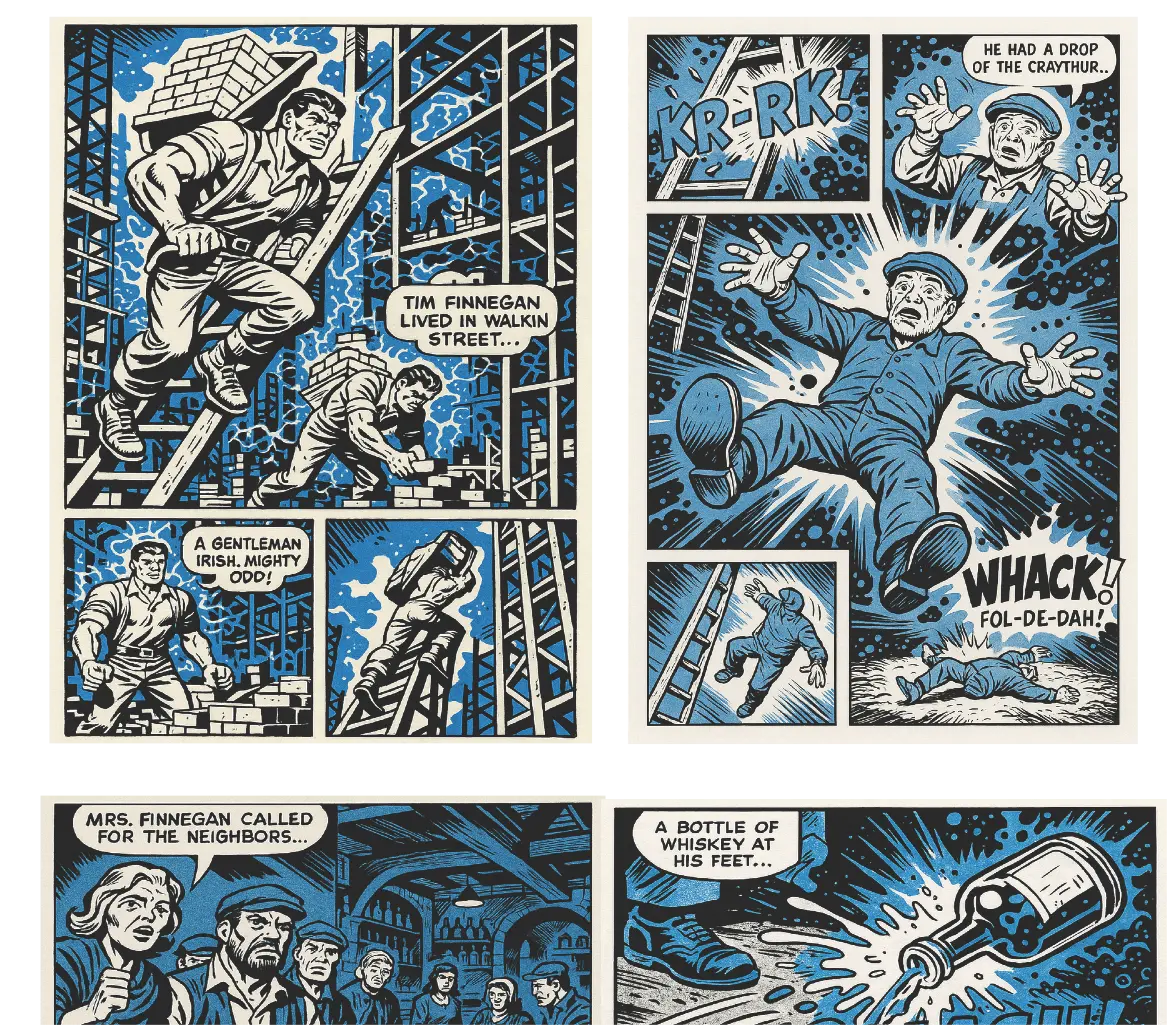
The title comes from the comic ballad Finnegan's Wake, in which Tim Finnegan falls off a ladder, is presumed dead, and sits up during his own wake when whiskey gets spilled on him.

Joyce dropped the apostrophe — making the title less about one man's wake and more about all Finnegans waking. The fall is not simply tragic. It is comic, and it is regenerative. To fall is also to make another rising possible.

Dream logic & the trouble with words

The book is usually described as taking place inside a dream — possibly HCE's, though this is never fixed. In dreams people become other people, places shift, time folds and words behave strangely. Joyce reproduces that in the language itself: portmanteau words, multilingual jokes, echoes, nursery rhymes, broken phrases. A single word may hold English, French, Latin, Irish and German at once.

This is what makes it difficult, and it is also the entire argument. Language is not clean and simple; it is layered, historical, comic, unstable and alive. Which is why the Wake mixes high and low so freely — Biblical myth beside pub gossip, ancient history beside dirty jokes, philosophy beside music hall. Joyce refuses to separate the sacred from the ridiculous. Human life contains both, usually in the same word.

Page 628 ends: “A way a lone a last a loved a long the” — sentence continues on page 1.

KULTUR · No. 2 · Finnegans Wake02
KULTUR // The Reading RoomPage 03

Wemblex Comics

Here Comes Everybody

Finnegans Wake comic page: Phoenix Park, HCE and the fall
Evidence 03a — Here Comes Everybody, a page from the Wake
KULTUR · No. 2 · Finnegans Wake03
KULTUR // The Reading RoomPage 04

Plate

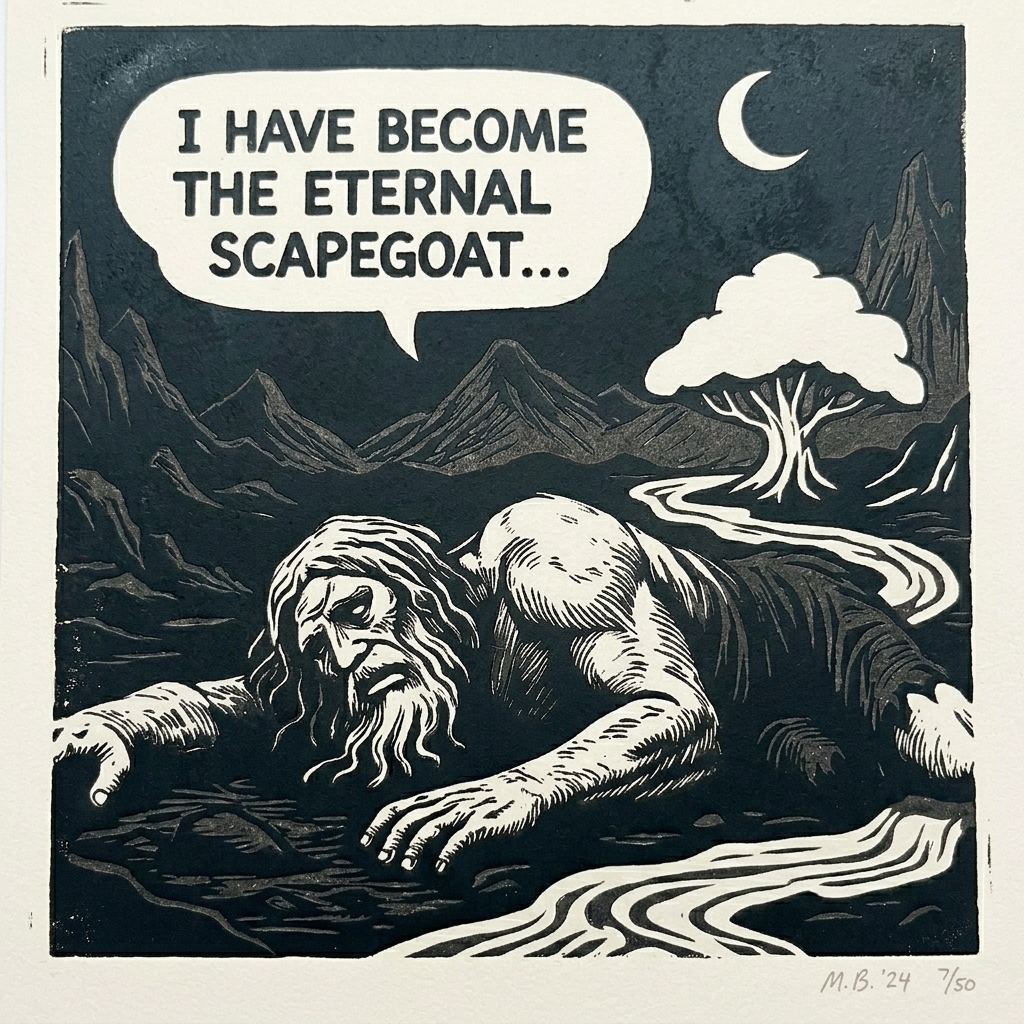
The Eternal Scapegoat

Linocut print: a fallen bearded giant in a moonlit river valley, speech balloon reading I have become the eternal scapegoat
“I have become the eternal scapegoat…” — linocut, M.B. ’24, 7/50. After HCE.
KULTUR · No. 2 · Finnegans Wake04